
Breakup & Relationship Counselling Singapore
The ending of a relationship can be an incredibly difficult experience, triggering a host of complex emotions and reactions. If you’re going through a break up in Singapore, it’s important to understand and process these feelings.
Almost all breakups are bad. Even if the long-term effect is dropping the dead weight of someone that’s not right for you. However, some breakups cause a little bit more grief, whether you are the one doling out the pain or on the receiving end.
Ghosting – Break Up
Ghosting cuts deep. When someone vanishes without a word, the emotional response is often intense and confusing. Being cut off without explanation can leave more that just confusion. It often stirs something deeper, like feelings of shame, self-doubt, and emotional abandonment.
It triggers emotional abandonment
For many, ghosting echoes past experiences of being dismissed or neglected. When someone disappears, it can reopen early wounds where emotional needs went unmet.
It removes the chance for closure
Most relationship endings come with at least some explanation or context. Ghosting leaves the other person with no clear narrative – just silence. That absence of meaning often fuels anxiety and obsessive thinking.
It creates a sudden emotional drop
This emotional whiplash and disconnect can disrupt your sense of safety and leave you feeling destabilised.
It affects your relational dignity
Being ghosted strips away the shared human process of ending things respectfully. You’re left carrying all the emotional weight, alone, without answers.
Ghosting is not just about miscommunication. It often hits the core of how we experience connection, rejection, and emotional safety.
Research studies show that people with anxious attachment styles may feel ghosted even more deeply. It can trigger old fears of abandonment, causing spirals of rumination and self-blame.
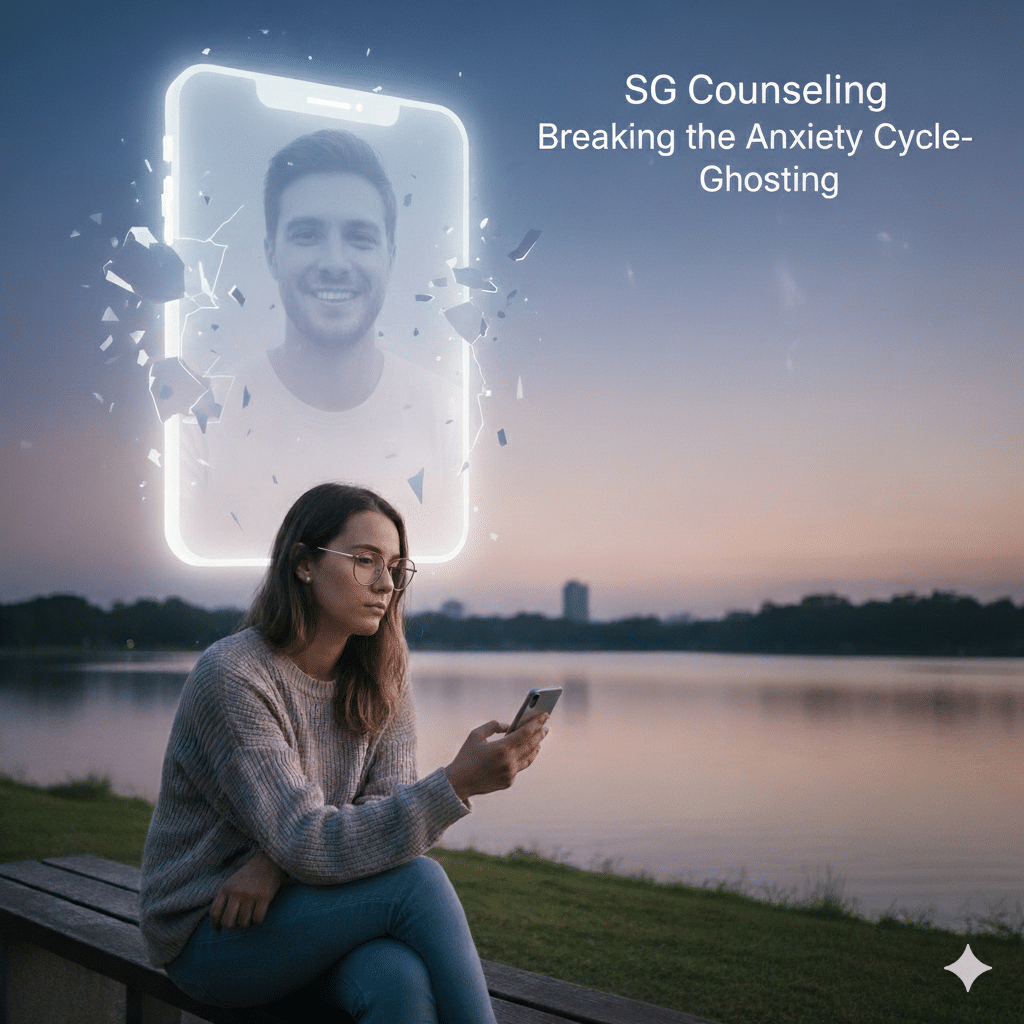

The Psychological Effects of Being Ghosted
When someone disappears without a word, it can feel as if your emotions were dismissed and your presence erased. The mind scrambles for answers, often turning inward, wondering what went wrong or what you did to deserve silence.
The emotional impact of ghosting can be intense and long-lasting, especially if it reactivates old patterns of rejection or neglect. If you’ve found yourself stuck in this kind of pain, you’re not imagining it. This experience can cause real psychological stress that deserves attention and care.
Anxiety and Hypervigilance
It’s common to feel constantly on edge, waiting for a message, fearing the silence, or anticipating rejection. This can place your nervous system in a prolonged state of alertness.
Shame and Self-Doubt
Questions like “Was I too much?” or “Did I do something wrong?” can become persistent. Ghosting often makes people turn inward, blaming themselves and doubting their worth.
Therapy For Deep healing
Sometimes ghosting reopens old wounds – abandonment, rejection, and emotional neglect. If this experience hits harder than it “should,” that’s not weakness. It’s a sign that something deeper may need tending. Therapy offers a compassionate space to unpack it, safely and at your own pace.
Will Help You to Rebuild Trust and Self-Worth After Ghosting
When ghosting shakes your sense of self, it’s not just about the relationship that ended. It often stirs up questions about your value, your ability to trust, and your readiness to open up again.
Restoring Emotional Safety in Small Ways
Start by paying attention to what feels safe and predictable in your daily life. Routine, healthy boundaries, and comforting rituals can help rebuild a sense of stability after emotional disruption.
Challenge the Inner Critic
The voice that tells you this was your fault or that you’re not lovable needs to be questioned, not believed. Ghosting says more about the other person’s capacity than it does about your worth.
The Profound Harm of On-again, Off-again Relationships
The core danger of a cyclical relationship pattern stems from the inherent and chronic instability it perpetuates. This dynamic fundamentally compromises an individual’s sense of psychological safety, often leading to an exponential increase in mental health strain that far outweighs the brief periods of reconciliation and happiness.
1. The Emotional and Neurobiological Toll
The repeated cycle of separation and reunion acts like an emotional roller coaster, placing the nervous system under immense duress.
Chronic Hyper-vigilance: When a relationship’s existence is always in question, the brain remains in a constant state of alert. This hyper-vigilance drains emotional reserves, leading to severe emotional exhaustion and making it nearly impossible to relax, trust, or fully commit. This state is clinically linked to heightened levels of anxiety and difficulty regulating mood.
Erosion of Self-Worth: Each break-up and re-initiation reinforces a cycle of self-doubt. The individual is left questioning their value (“Why am I not enough to keep them?”) and their judgment (“Why do I keep accepting this instability?”). This pattern systematically dismantles self-esteem, making the individual more susceptible to depressive symptoms and reliance on the partner for validation.
The Attachment Trap (Trauma Bonding): The extreme intensity of these relationships is often mistaken for deep passion. However, the feeling of euphoria during the reunion is often just the profound relief from the pain of separation. This creates an addictive, almost-traumatic bond where the partners are connected by the drama of the cycle, rather than a healthy, secure connection. This is a common indication of insecure attachment styles being activated and reinforced.


2. Deep Relational Dysfunction
The cyclical pattern teaches the couple that their commitment is conditional and that leaving is the primary conflict resolution mechanism, effectively poisoning the foundation of the partnership.
Compromised Trust and Future Vision: A relationship cannot mature without the foundation of reliable trust and commitment. How can two people build a long-term future (financially, emotionally, socially) when the foundation is repeatedly pulled out from under them? The lack of psychological safety prevents the couple from having the necessary, difficult conversations required to address the true root causes of their conflict.
Neglect of Root Issues: As research suggests, couples in this pattern must ‘look under the hood’ to examine the ‘why’s and how’s’ of their repeated splits. Often, the rush to reconcile—fueled by fear of loneliness or intense nostalgia—overrides the necessary scrutiny of the underlying systemic flaws: perhaps mismatched values, irreconcilable differences, or underdeveloped conflict resolution skills. Reconciliation without addressing these core issues is merely a temporary reprieve, guaranteeing the cycle will repeat.
Normalizing Unhealthy Drama: For many, the “highs” and “lows” become the accepted baseline of what love feels like. This normalizes crisis and drama, leading to a distorted view of healthy partnership, where a truly stable, secure relationship might feel “boring” or lack the manufactured intensity they have become accustomed to.
3. Therapeutic Direction
If you are caught in this loop, the therapeutic work involves moving beyond the surface drama to explore the internal scripts and external patterns that keep you tethered to the instability. This involves:
Mapping the Function: Identifying what emotional needs the cycle itself is serving (e.g., are you avoiding true intimacy? Are you afraid of being alone?).
Developing Emotional Stability: Learning techniques for self-soothing and emotional regulation so that the fear of loss does not automatically trigger the impulse to return to an unhealthy pattern.
Making a Conscious Choice: Ultimately, the path forward requires a brave, honest assessment: Are the core issues truly solvable? Or has the pattern become toxic and inherently unhealthy, meaning that the most powerful act of self-care is to exit the cycle permanently and safely preserve your well-being.
The Vicious Cycle: Understanding and Breaking Free
The classic on-again, off-again relationship is a textbook example of an emotional rollercoaster—a dynamic characterized by intense, intoxicating highs during reconciliation followed inevitably by the crushing lows of repeated, painful breakups. This pattern is often mistaken for profound passion or destiny, but it is, in reality, a vicious cycle that prevents true relational health.
While the “on” phases may feel intensely passionate, that feeling is frequently driven by the relief of proximity (the reduction of separation anxiety) rather than secure, sustainable intimacy. These cycles cause significant, cumulative emotional harm, creating chronic instability that consumes both partners’ mental and emotional resources. Crucially, this pattern prevents individuals from developing the relational skills necessary for forming genuinely healthy, sustainable connections.

The Mechanics of the Vicious Cycle
The cycle persists not because the love is strong, but often because the underlying emotional issues are so persistent:
The Insecure Attachment Dance: One partner, or both, may struggle with an insecure attachment style (e.g., anxious or avoidant). The anxious partner fears abandonment and rushes back in for comfort (the “on”), while the avoidant partner fears engulfment and pushes away (the “off”). They are magnetically drawn to and repelled by each other, feeding a cycle of craving and rejection.
The Illusion of the “Perfect Partner”: When apart, we tend to romanticize the relationship, forgetting the pain and focusing solely on the positive memories. This nostalgic distortion makes the thought of reunion irresistible, driving the “on” phase. The moment the couple is back together, the old, unresolved issues resurface, driving them apart again.
Unlearning Healthy Coping: The emotional intensity of the cycle becomes a form of reward. The partners learn to associate resolution (the reunion) with extreme drama (the break-up), conditioning them to escalate problems rather than calmly communicate and collaborate to solve them. This fundamentally damages their ability to form stable, peaceful relationships.
Understanding these dynamics is the indispensable first step toward regaining control and breaking free from this self-perpetuating pattern.
The Essential Step: Seeking Professional Intervention

As a senior counsellor and psychotherapist, I advise that if you and your partner find yourselves repeatedly trapped in an on-again, off-again pattern, it is a clear signal that the issues are systemic and cannot be solved through willpower or temporary reconciliations alone.
You need professional help to illuminate the ‘blind spots’ that keep the cycle turning.
Why Counselling is Necessary:
Neutral Ground: A therapist provides a neutral, safe space free from the emotional charge of the relationship. This external perspective is critical for seeing the cycle objectively and understanding the underlying issues, such as insecure attachment or poor conflict resolution skills.
Identifying the Root Cause: My role is to help you move past the symptoms (the breakups) and identify the true root causes (e.g., fear of intimacy, control issues, core incompatibility, or trauma bonding).
Developing New Scripts: We work to develop concrete, functional skills:
Emotional Regulation: Learning how to manage the intense lows without resorting to panicked reconnection.
Direct Communication: Learning to articulate needs and boundaries without using withdrawal or abandonment as a threat.
Commitment Clarity: Helping couples make an informed, final decision: either commit fully to resolving the root issues (with the understanding that if the cycle repeats, the relationship must end) or commit to a safe and permanent separation to protect individual well-being.
Seeking professional help is not a sign of failure; it is an act of courage and the most responsible step toward creating a stable, functional relationship—whether that relationship is with your partner or with yourself.